


Tuesday, 12 September 2006
6-day drive: Christchurch to Milford Sound to Queenstown
Six days Christchurch to Queenstown - including Mt Cook, Dunedin & Milford Sound
General
You are contemplating a Tranz Alpine train trip and a bundle of tours. We do recommend the train trip, but in your case, you will see similar spectacular scenery by road, and the train trip really is best for times when the mountains are snow capped. Coach tours are plentiful but very “packaged” and touristy/busy as a result. It will be just as cheap for a group of 5 to hire a Tarago or similar, (which will comfortably take your group and baggage), and drive independently. The road rules are the same as Australia with just one or two exceptions; the roads are good, and safe. Much more leisurely, quiet, and enjoyable.
Day 1 Afternoon in Christchurch
When you arrive pick up the car at the Airport, and take accommodation either near the Airport (many Motels) or in the City Centre. In my opinion, staying centrally will maximise your available time. A really great Hotel is the Crowne Plaza. Its 5 star and expensive but ideally situated to maximise your time in Christchurch itself. Just a Riverside stroll to key areas, and has a great ambience. It is a genuine favourite place to stay for us. Alternately Rydges Hotel is in a central position in the city.
The afternoon allows you some time for local sightseeing in the Garden City. Special highlights include a walk along the Avon River, perhaps enjoying a short punt ride down the River and back instead of walking. The tourist tram runs around the key tourist spots and visits things like the Info Centre/ mini museum, the Cathedral, the Arts and Craft centre, the new Art Gallery and the Museum, as well as the Christchurch Gardens, which are really all worth a visit.
Day 2 Christchurch to Mt Cook (Christchurch Mt Cook direct 330 km)
If time permits two side drives out of Christchurch are worth considering. One is out to Akaroa, an historical French settlement in the crater of an extinct volcano now open to the sea, which is interesting and the town has a special French ambience. That’s a half-day minimum. A shorter drive, about 1.5 hours, could take you to the port of Lyttleton via the Christchurch Hills area. Very quaint, European, old style buildings etc and easy to do.
Another great thing to do is take breakfast in the gardens at the Teahouse. Very pleasant setting and great Eggs Benedict.
Proceed towards the West Coast on H23 until you reach Darfield. Turn off towards Mt Hutt and Methven. This drive goes through open sheep/cattle country, crosses the Rakaia Gorge and ends up at Geraldine following a (sealed, safe, quiet) back country route which is 10 times prettier than the boring and busy H1 coastal road to Timaru. It’s about 20 Kms longer.
Geraldine has a popular bar/diner in the centre of town called the Village Inn, adjacent to an open car park and a pleasant short River Walk. The food and service here are good, and it’s a good place for an intermediate stop on the way to Mt Cook.


Proceed along H79 to Fairlea where you intersect H8 and travel on to Tekapo. Tekapo has a pretty blue lake, and is famous for the Church of the Good Shepherd, with a picture window in the Church, which overlooks the Lake and the snow capped mountains, and creates a special feeling of contact with God/Nature, whatever you conceive him/her/it to be.



The Hermitage at Mt Cook is always busy, especially around lunchtime when the tourist coaches drop in. Try to avoid the 12-2 rush.
The restaurants and bars offer special views and you should take time to stop and experience the feeling of the Resort itself. The sunsets are spectacular, usually, but remember to organise a place to stay because the closest accommodations are a fair drive away. You can stay at Mt Cook, Tekapo, or Twizel, but why not enjoy Mt Cook, eat at the very special Panorama Room at The Hermitage, and take in the evening beauty the sunset and the stars. There is a variety of accommodation at Mt Cook from bunkrooms through family style motel units to luxury rooms.
The Mountaineer Restaurant (also at Mt Cook) is simpler fare, and is separate from the main Resort Hotel, but is a meeting place for trampers and guides, has a nice mountain outlook, especially at sunset, and is an alternative place to take a meal.


Day 3 Mt Cook to Dunedin (direct 331 Kms)
The drive to Dunedin is about 4 hours but if you are planning to see the Albatross, seal and Penguins you will need to travel out on the Otago Peninsula to Tairoa Heads, and this looks a short distance. In fact it is highly scenic, narrow, and winds a fair bit, so an extra hour should be planned.
On the road, the first major town is Twizel, built/extended to house the workers on the major hydro-electric schemes of the area en they were being built.
At Omarama, a useful rest/food stop/fuel stop there is an interesting place called “Clay Cliffs”. Clearly signposted just before you enter town, you turn off to the right and proceed along an unsurfaced road about 5 Kms. Honesty box at gate. Proceed as far as you can by car. There is at least one gate which needs to be opened & closed as you pass through.
The cliffs are a natural feature, sculpted by rain and wind, and are hard to describe. About 50-70m high stretching about a kilometre. Sheer cliffs, stalagmite type pinnacles, little valleys and grottos, interesting formations of all sorts, and while geologically fascinating, kids also enjoy the fantasy-like aura of the place. Takes about 1.5 hours from the main road turnoff. Used in Lord of Rings films.
Proceed along Highway 83 via the Lake Benmore hydro electric dams and Lakes which are fed from the Alps. Quite an interesting drive, once again with wonderfully coloured Lakes. Oamaru is a coastal town with art deco buildings etc but is usually not a main tourist destination. Proceed through to Dunedin, which was the main city of New Zealand at the time of the 1860s gold rush. It is now second in size to Christchurch, and is regarded as a University City, with mainly a Scottish influence.
There is a wonderful transport Museum at the station where the Taieri Gorge train departs daily at 12:30 returning 4:30pm. This is a scenic trip but would have to be deferred till tomorrow if you are keen to see the wildlife at Tairoa.


We can prearrange your access to the wildlife reserves if you wish and its wonderful to see the wildlife at dusk when the penguins and Albatross come in from feeding.
We can also organise an overnight stay at Larnach Castle. 

 Set high on the Peninsula the “castle” is a v

 ery large home with castle like features built by an early settlor/banker/developer/ politician and the castle has a wonderful history and aura to it, both in the building and the grounds themselves. You can dine at night in the Castle Dining Room, about 8-10 people around the one large table, an interesting opportunity to meet and chat with others, and you can stay either in the “Stables” or in specially constructed theme rooms nearby the castle itself. The breakfasts are great and you will have time to explore the castle in the morning but start early as Coaches roll in about 9am!! Be warned.
Day 4 Dunedin to Queenstown 283 Kilometres
The trip to Queenstown is only 3.5 hours direct, but remember that you are on the Peninsula and have to allow another half an hour at least to get back to Dunedin itself. You can spend time in Dunedin if required, driving through to Queenstown in the afternoon, proceeding south along the coast to Milton, where you turn inland.
The drive is scenic and passes through old Gold Mining towns like Lawrence and fruit growing towns like Roxburgh. There is some special rocky scenery between Roxburgh and Alexandra which is unique and an old stone Inn about 30 minutes past Roxburgh serves snacks and soups and coffee etc if you need a break. Alexandra/Clyde is a rural town serving the area but nothing of great significance here beyond the hydro dams/Lakes etc which abound in the area. Proceed to Cromwell.


The whole gold mining area around Queenstown starts here and proceeds up the Kawerau Gorge through towns such as Bannockburn and Gibbston. Look out for the old mining site about 10 Kms south of Cromwell which you can visit if you wish. The Gorge contains the Kawarau River, which drains Lake Wakatipu on which Queenstown sits, so we are close to Queenstown now. On the way through the Gorge look out for the first hydro station at Roaring Meg stream and also new Wineries. There are about 5 or 6 now, of which Gibbston Valley and Chard Farm wineries are probably the best, in terms of both tourist features and wine quality. Both offer tasting and Gibbston has a large Restaurant and Wine cave as well. If you travel to Chard Farm, look out for the “Valley of Kings” scene from Lord of the Rings filmed here, as you return towards the highway.
Both wineries are close to the “Bungy Bridge” where A J Hackett launched the bungy concept 20 years ago. Stop off and watch a few crazy people jump.
The road then winds 10 minutes back into Queenstown itself via Lake Hayes, which often offers good photographic opportunities. Adelle will arrange accommodation in Queenstown if you wish.
We suggest that if time permits you take the Gondola up to the restaurant at the top and take an evening meal after the Maori concert. This is a staged event of course, but gives insight into Maori culture and songs and of course the “haka”. The meal is International, buffet style, where you can also sample Maori “hangi” food cooked underground, if you choose. Or simply spread out the meal over several hours enjoying the lights of Queenstown below, and the entertainment. There is usually a singer or a group performing.
Day 5 Queenstown to Milford Sound 291 Kilometres


Should you choose this option you need to arrive by about 4pm which requires you leave Queenstown no later than 1130 am. (Arrival time may vary according to time of year)
But that would allow you to do something in the morning, possibly a jet boat ride, or a stroll through town, a walk in the gardens etc. There are heaps of activities here. Assuming you leave later rather than earlier you proceed down the Lake via Highway 6 through Kingston, and Athol. The turnoff is clearly marked at Five Rivers, towards Mossburn, Te Anau and Milford Sound. Te Anau is a beautiful lakeside town, and a useful comfort stop, refreshment stop and fuelling stop as there is no fuel for another 250 Kms.
About 30 minutes from Te Anau the drive becomes spectacular, and depending on the weather will include many waterfalls and snow-capped peaks. There are clearly marked lookout spots and photo opportunities as you wind down the glacial valleys towards Milford.
As you may be concerned about meeting up with the boat at 4:00 pm, remember that you can take advantage of the scenic spots on the way out in the morning as well. With this in mind remember one spot not so well known or marked which is rather special. 

 There is only one turn off from the main road as you proceed towards Milford, called the Lower Hollyford Road. It branches right (North) as you head West to the Sound. About 1 Km down that dirt road there is a parking area and a suspension bridge crossing the River. Cross the River and walk in about 10 minutes to some spectacular waterfalls, suspended walkways, and steep sided gorges as the stream drains a high mountain Lake called Lake Christina (I think). Other features worth a look are the Mirror Lakes and The Chasm, but the scenery generally is just awesome.
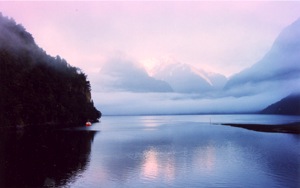
Enjoy the Milford Sound, and rise early on the boat to catch the sunrise and the mists in the Sound itself.
Day 6 Milford Sound to Queenstown
Depending on sightseeing on the way back you could be back in Queenstown by about midday. There are nice things to see and do in Te Anau, including the Glow Worm caves, but this takes about two hours to do involving a trip across the lake and a walk into a river cave on the other side. Kingston has an historic steam loco and rolling stock if you an enthusiast and you may see it alongside the road as it runs day tours around midday.
The afternoon in Queenstown, the evening, and the following morning are free. The separate list of things to do will ensure you are not bored.
Day 7 Queenstown to Sydney
Return the car to the Airport. Allowing an hour for check in, you need to leave the accommodation 75 minutes

Kayaking on Milford


